
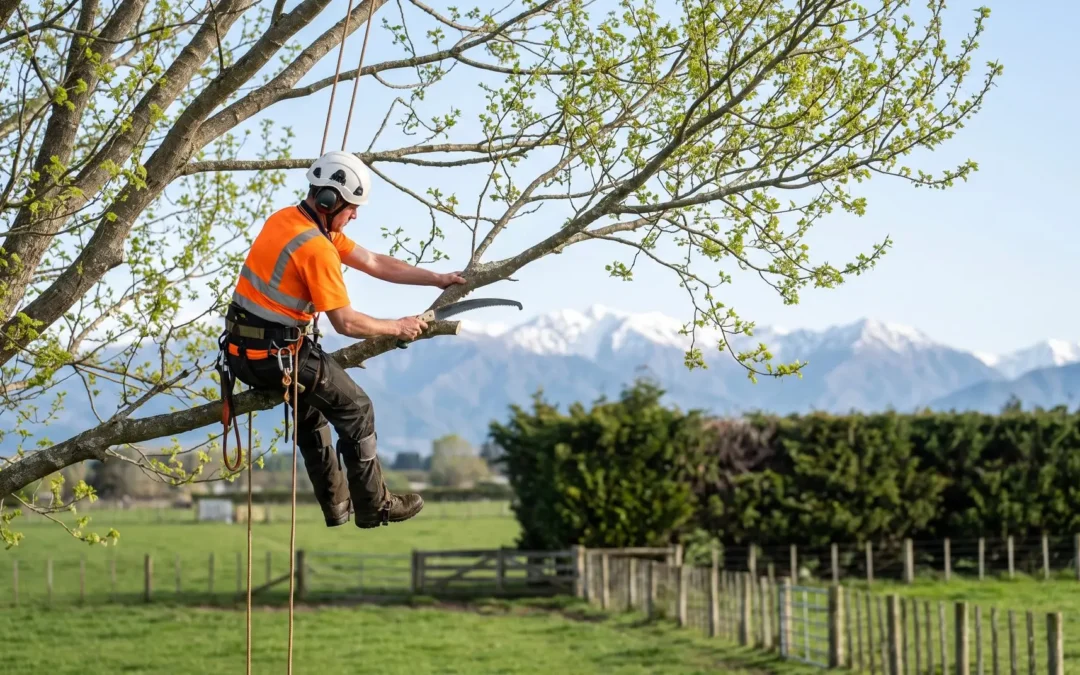
Spring has arrived in Levin, and your trees know it before you do. Buds are swelling, sap is moving, and the growth your trees put on over the next few months shapes how well they handle wind, weight and summer dry for the rest of the year. Get your spring pruning right and a tree grows stronger, safer and better looking. Prune the wrong tree at the wrong time, and you can invite disease, pests, and even a fine under legislation most people have never heard of.
This guide covers what to prune in spring across Levin and the wider Horowhenua district, what to leave alone until later, and the rules that apply to spring tree work here, from nesting birds to a power line deadline that lands on 16 October 2026. Whether you’ve got a single tree on a Fairfield section or a long run of shelterbelt out near Ohau, it’s written to help you make the right call for your property.
Key Takeaways
- Light structural pruning and deadwood removal suit early spring, before trees push their main flush of new growth; heavy pruning straight after that flush stresses a tree when its energy reserves are at their lowest
- Spring is the windiest season across the Manawatū-Whanganui region, so it’s the right time to deal with winter storm damage and weak limbs before they fail
- Stone fruit and citrus are the big exceptions: stone fruit is best pruned after harvest to reduce silver leaf risk, and citrus between April and August to avoid lemon tree borer
- Native bird nesting season runs roughly from August to January, and disturbing the nest of a protected bird is an offence under the Wildlife Act 1953
- The grace period for the updated Electricity (Hazards from Trees) Regulations ends on 16 October 2026, and only Electra or an Electra-approved contractor may work within four metres of a power line
- Macrocarpa and most other conifers won’t regrow from bare brown wood, so shelterbelts need regular side trimming rather than one heavy cut every few years
Why Spring Matters for Trees in Levin and Horowhenua
What’s Happening Inside Your Trees Right Now
Through winter, a tree runs on the energy it stored the previous season, held as carbohydrates in its roots, trunk and branches. In spring it spends a large share of that reserve in one go, pushing out new leaves and shoots. Until those leaves are fully working and making energy of their own, the tree is effectively living off its savings.
That’s why timing matters so much. Growth and wound closure are strongest when pruning happens just before the spring flush, while the tree still has its reserves to draw on and is about to grow new tissue over the cuts. Heavy pruning of live wood straight after the flush is the opposite: the tree has just spent its energy on leaves, and you’re removing them before they’ve paid it back.
For most deciduous trees, early spring is also the easiest time to read a tree’s structure. With the canopy still open, crossing branches, weak unions and poorly placed limbs are easy to see. By late spring, the same tree is a wall of leaves.
A few species, maples and birches among them, will “bleed” sap from cuts made in early spring. It looks alarming, but it rarely does the tree any real harm.
Spring Is Horowhenua’s Windiest Season
Across the Manawatū-Whanganui region, spring is the windiest time of year. NIWA’s climate records for the Levin automatic weather station show average wind speeds peaking in October and November, at around 12.5 km/h, against an annual average of about 10.1 km/h.
Levin is actually more sheltered than much of the region. It records around 22 days a year with gusts above 63 km/h, compared with around 50 in Palmerston North, and the prevailing wind is westerly. But the district’s most damaging wind events have tended to come from the east. Levin’s highest recorded gust was 128 km/h from the east in July 1978. In July 2008, gale-force easterlies brought trees down across roads and tore roofs off homes around Levin, and a month later a tornado in Weraroa destroyed around 20 trees in a single strike.
The practical point is simple. A tree that came through winter with a cracked limb, a loosened root plate or a storm-damaged branch hanging in the canopy is about to be tested by the windiest months of the year. A spring check catches those problems while they’re still a pruning job rather than an emergency callout.
Signs worth looking for after winter include:
- Broken branches still hanging in the canopy (arborists call them “hangers”)
- Fresh cracks or splits where two stems meet
- Soil lifting or cracking around the base of the tree
- A lean that wasn’t there last year
- Fungal brackets or soft, crumbling wood on the trunk or main limbs
What to Prune in Spring (and What to Leave Alone)
Good Spring Pruning Jobs
Deadwood removal. Spring is the easiest time of year to find it. Once the live branches leaf out, dead ones stay bare and stand out clearly. Removing deadwood takes nothing from the tree’s energy supply and reduces the risk of limbs dropping in spring winds.
Cleaning up winter storm damage. Ragged breaks heal poorly and invite decay. Cutting them back cleanly to a proper point, just outside the branch collar, gives the tree the best chance to seal the wound.
Crossing and rubbing branches. Two branches rubbing together wear through each other’s bark and create an entry point for disease. Removing one of them early is a small cut. Leaving it for years turns it into a big one.
Formative pruning on young trees. This is where spring pruning earns its keep. Guiding a young tree toward a single strong leader and well-spaced branches is done best little and often, while the branches are small and the cuts close quickly. A few minutes with secateurs on a young tree now can save a major structural problem, and a much bigger bill, in fifteen years.
Clearance work. Branches over driveways, paths, roofs and gutters are worth dealing with before the spring growth adds length and weight to them.
Spring-flowering trees and shrubs. Anything that flowers in spring is best pruned after flowering finishes, otherwise you cut off this season’s display. For ornamental cherries and plums, keep it light and choose a dry day, because they belong to the same family as stone fruit and share the same silver leaf risk (see below).
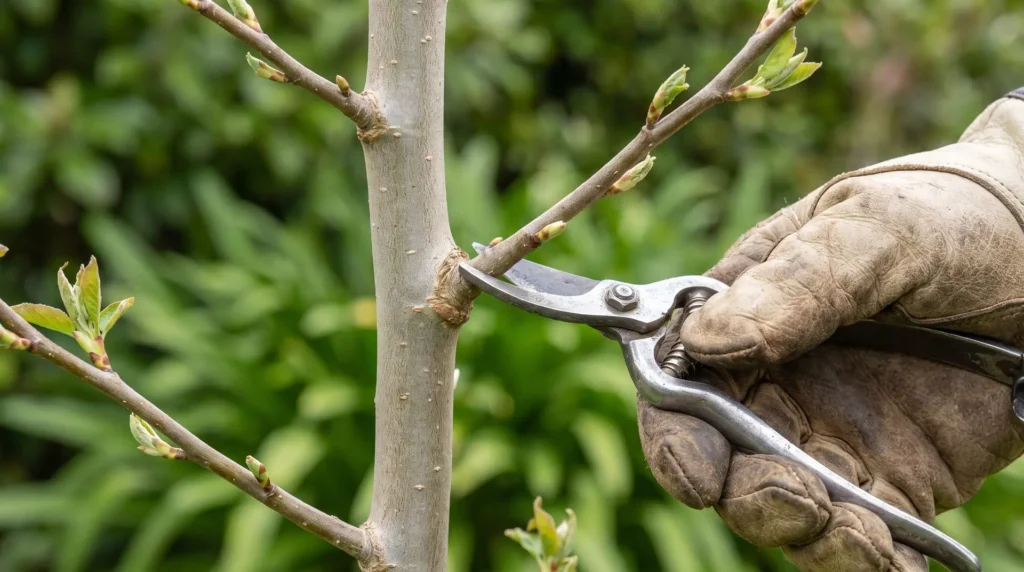
Stone Fruit: Wait Until After Harvest
Plums, cherries, peaches, nectarines and apricots are the classic exception to the “prune in the cooler months” rule. The reason is silver leaf, a fungal disease caused by Chondrostereum purpureum.
Silver leaf spores infect trees through fresh wounds, and pruning cuts are the main way in. The fungus favours cool, wet weather, and spore numbers are higher through winter and early spring. There’s no chemical cure once a tree is infected, so prevention is everything.
The standard advice is to prune stone fruit lightly in summer, straight after harvest, on a dry day. Signs of infection include a dull, silvery sheen on the leaves, dieback of the affected branch, and a dark stain in the wood when you cut across it. Infected branches should be cut out well below the staining and removed from the property rather than left lying around, since dead wood can go on to produce more spores.
Citrus: Leave It Until Autumn
Lemons, limes, mandarins and oranges have their own spring hazard: the lemon tree borer (Oemona hirta), a native longhorn beetle.
The adult beetles fly at night from mid-spring through to autumn, and the scent of freshly cut citrus draws them in. They lay their eggs in fresh wounds, and the larvae tunnel through the branches for a year or two, weakening them until they snap or die back. That’s why the usual guidance is to prune citrus between April and August, outside the beetles’ flying season.
Signs of borer include small round holes of 2-3 mm in the branches, clumps of sawdust-like material around them, and sudden dieback of individual branches. If you have to make a cut on citrus in spring, such as removing a broken branch, keep it clean and seal it. And keep line trimmers away from the base of the trunk, because a scuffed trunk makes an ideal place for the beetle to lay its eggs.
Shelterbelt and Hedge Care on Horowhenua Lifestyle Blocks
The Brown Wood Rule
Macrocarpa is one of New Zealand’s most widely used shelterbelt species, and it’s a familiar sight on farms and lifestyle blocks right across Horowhenua. Like most conifers, it has one characteristic that catches people out: it won’t reshoot from bare brown wood.
Cut back past the green foliage into the older wood inside, and that face of the shelterbelt stays bare, often for good. That’s why a shelterbelt that’s been left for years and then given one heavy cut can end up as a brown wall on one side. The same rule applies to most pines and other conifer hedges.
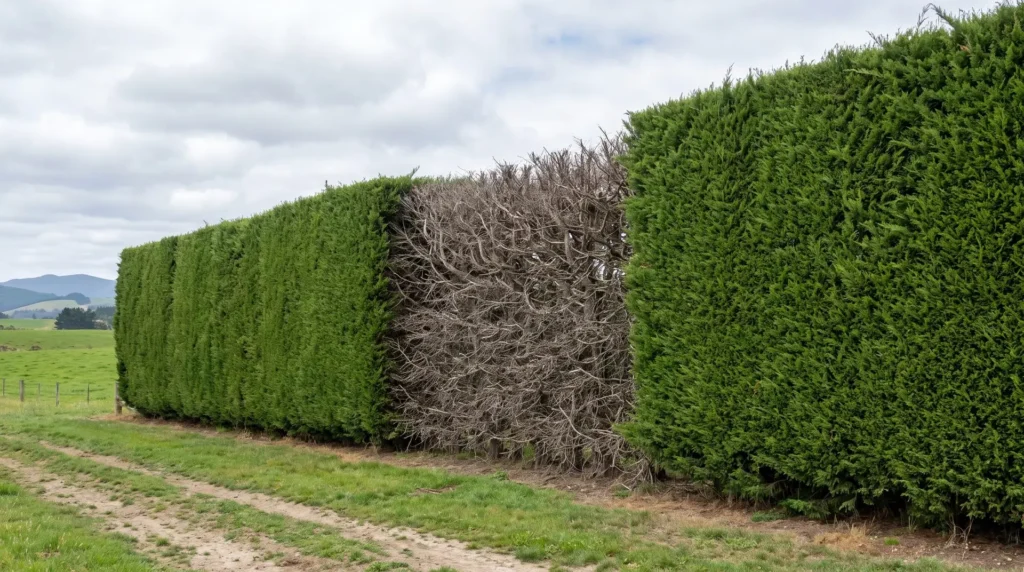
Little and Often, Wider at the Base
The answer is regular side trimming that keeps the green face where you want it. Shaping the shelterbelt slightly wider at the base than at the top, known as a batter, lets light reach the lower branches. When the top is left wider than the bottom, the base is shaded out, thins, and eventually goes bare in a way that takes years to recover.
There’s a catch with light trims, though. Taking just the soft outer growth year after year leaves the heavy wood in the centre free to keep growing taller and thicker. Eventually that structural wood needs reducing, which is height work with real weight involved, and it’s arborist territory rather than a job for a hedge trimmer on a ladder.
Spring is a good time to walk your shelterbelts and plan the work. Because hedges and shelterbelts are prime nesting habitat, the heavier trimming is often best scheduled for late summer or autumn, once the main nesting season has passed. That brings us to the spring rule most people miss.
Nesting Season: The Spring Rule Most People Miss
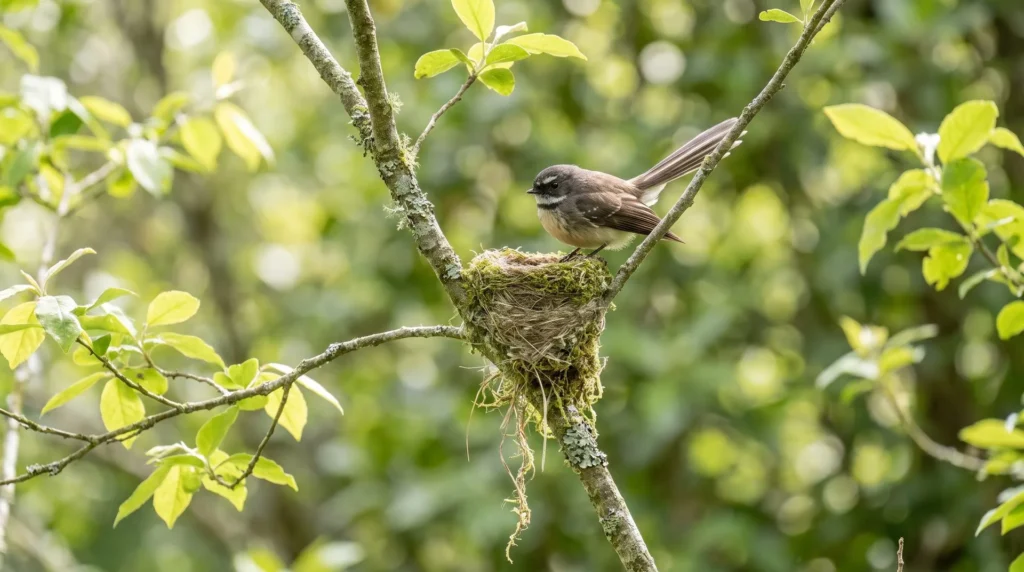
The Wildlife Act 1953 protects all of New Zealand’s native birds, and it’s an offence to disturb or destroy the nest of protected wildlife. The main nesting season runs roughly from August to January, and species like tūī, kererū and pīwakawaka (fantails) may be raising chicks in tree canopies, hedges and dense shrubs right through spring.
The Act applies on all land, private property included. Penalties are serious: for absolutely protected species, individuals face fines of up to $100,000 or up to two years’ imprisonment.
None of this means spring pruning has to stop. There’s no blanket ban on trimming trees in spring. It means checking before you cut, which is exactly how we approach every spring job:
- We inspect the canopy, hedge or shelterbelt for signs of nesting before any work starts
- If we find an active nest of a protected species, that section waits until the chicks have fledged
- Light work well away from a nest may still be possible, but heavy or structural pruning near it is left for later
Trees Near Power Lines: The 16 October 2026 Deadline
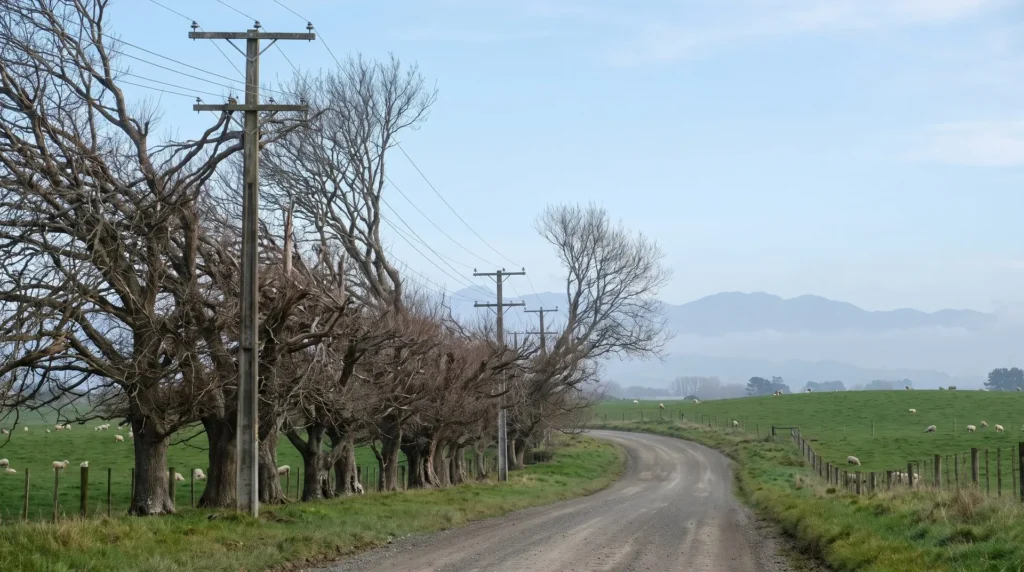
If you’ve got trees growing anywhere near overhead lines, this spring comes with a date to note. Electra owns the electricity network serving Horowhenua and Kāpiti, and under the Electricity (Hazards from Trees) Regulations 2003, tree owners are responsible for keeping their trees clear of the lines.
The regulations set a “Growth Limit Zone” around each line that trees must stay out of. For typical local spans of up to 150 metres, Electra lists the minimum distances as:
- Low voltage lines (230 V / 400 V): 0.5 m
- 11 kV lines: 1.6 m
- 33 kV lines: 2.5 m
- 50-66 kV lines: 3.0 m
- Above 66 kV: 4.0 m
The regulations were updated in October 2024, increasing some minimum safe distances and adding a new “clear to the sky” requirement for certain lines. There’s been a grace period to give tree owners time to comply, and it ends on 16 October 2026.
Two other points matter just as much. First, no one may work within four metres of a power line (the Controlled Access Zone) without Electra’s approval, so tree work inside that zone must be done by Electra or an Electra-approved contractor. Second, Electra may cover the cost of the first cut or trim if certain conditions are met, such as the tree never having had an Electra-funded cut before. After that, ongoing maintenance is the tree owner’s responsibility, and owners can be liable for damage their trees cause to the network.
When we assess a property, we’ll tell you straight whether any of your trees fall inside that four-metre zone. We handle the work outside it, and we’ll point you to Electra for anything inside it, so the job gets done safely and legally. And if you’re planting this spring, Electra’s advice is to keep fast-growing trees that reach over six metres, like poplars, gums and willows, well away from the lines.
Safety and Compliance for Spring Tree Work in Horowhenua
Notable Trees and the Horowhenua District Plan
Some trees in the district are protected in their own right. Trees listed in Schedule 3 of the Horowhenua District Plan, the Notable Trees schedule, can’t be removed, damaged or destroyed without going through Horowhenua District Council’s process first. Listed trees range from ancient natives to well-known exotic plantings, including a notable rimu recorded in Shannon.
It’s worth checking the schedule before any significant pruning. Work near Lake Horowhenua, waterways or wetland margins can also involve Horizons Regional Council, so it pays to confirm which authority’s rules apply before the saw comes out.
Boundary Trees and Your Neighbours
Spring growth is often when overhanging branches become impossible to ignore. Under the Property Law Act 2007, you’re generally entitled to cut back branches or roots encroaching onto your property, as far as the boundary. There are some limits that matter:
- Talk to your neighbour first; most boundary tree issues are solved over the fence
- Don’t cross onto their property to do the work, and don’t cause unnecessary damage to the tree
- The cuttings, and any fruit, still belong to the tree’s owner
- Check the tree isn’t protected before cutting anything
Where a neighbour’s tree is dangerous, or unreasonably blocking light or views, the District Court can order it to be trimmed or removed under sections 332 to 338 of the Act.
Ladders, Chainsaws and Working at Height
The most common way spring pruning goes wrong has nothing to do with the tree. A ladder, a chainsaw and a branch under tension are a dangerous combination, and a branch can move in ways that are hard to predict until it’s already moving.
Professional arborists work under the Health and Safety at Work Act 2015, with rope access systems, rigging to control falling wood, and full protective gear. As a rule of thumb, if the job needs a saw and your feet off the ground, it’s a job for a qualified arborist.
How Much Pruning Is Too Much?
Every cut removes leaves, and leaves are how a tree feeds itself. That’s why arborists talk about the “pruning dose”, the share of a tree’s live foliage removed at one time.
Older editions of the widely used ANSI A300 pruning standard set a ceiling of 25 percent of live foliage in a growing season. The current standard has moved away from a single number, requiring instead that no more living material is removed than the objective actually needs, judged on the tree’s species, age and condition. In practice, around 10 to 15 percent is more typical for a mature tree, and a stressed or declining tree should have less taken still.
A few practices do lasting harm and are worth avoiding:
- Topping, cutting a tree’s main stems back to stubs, triggers a flush of weakly attached shoots that are prone to breaking in wind
- Lion’s tailing, stripping the inner branches and leaving foliage only at the tips, weakens branches and exposes bark to sunburn
- Flush cuts, made hard against the trunk, remove the branch collar the tree uses to seal the wound
On wound paint, current guidance is that most pruning cuts heal best left alone. The exceptions are the high-risk cases covered above: a sealant is worth using on citrus cuts during borer season and on stone fruit where silver leaf is a concern.
Spring Pruning Costs in Levin and Horowhenua
Pricing for tree work depends on the job rather than a flat rate. As a general guide, smaller trees and straightforward pruning typically start from $150-500. Medium trees, or jobs with moderate access difficulty, usually land in the $500-1,200 range. Larger or more complex work, including tall shelterbelt reductions or jobs needing extensive rigging, can run from $1,500-3,000 or more.
The factors that move the number include the height and spread of the tree, how easy the site is to access, how much green waste needs chipping and removing, and proximity to power lines or buildings. For shelterbelts, length and height matter most. And where a tree near a power line qualifies for Electra’s free first cut, that’s worth checking before paying for the work yourself.
A spring check is also one of the better-value calls you can make. Catching a cracked limb or a developing structural problem now costs far less than dealing with it after it fails in a November gale.
Your Spring Tree Checklist for Levin and Horowhenua
- Walk your property and look for winter storm damage, hanging branches and new leans
- Remove deadwood once the live branches have leafed out and it’s easy to spot
- Do formative pruning on young trees early in the season, while cuts are small
- Prune spring-flowering trees and shrubs after they finish flowering
- Leave stone fruit until after harvest, and citrus until autumn
- Check hedges, shelterbelts and canopies for nesting birds before any cutting
- Look up: note any trees growing toward power lines before 16 October 2026
- Check the Horowhenua District Plan’s Notable Trees schedule before significant work
- Talk to your neighbour before trimming anything along the boundary
- Call an arborist for anything involving height, a chainsaw, or doubt
Conclusion
Spring pruning in Horowhenua is about timing as much as technique. Work done before the spring flush helps a tree grow strong. The same cut made at the wrong moment, or on the wrong species, can open the door to disease, pests or a legal problem. Add the district’s windiest season, the start of nesting season and a power line deadline, and spring is the time of year when a professional eye pays for itself most clearly.
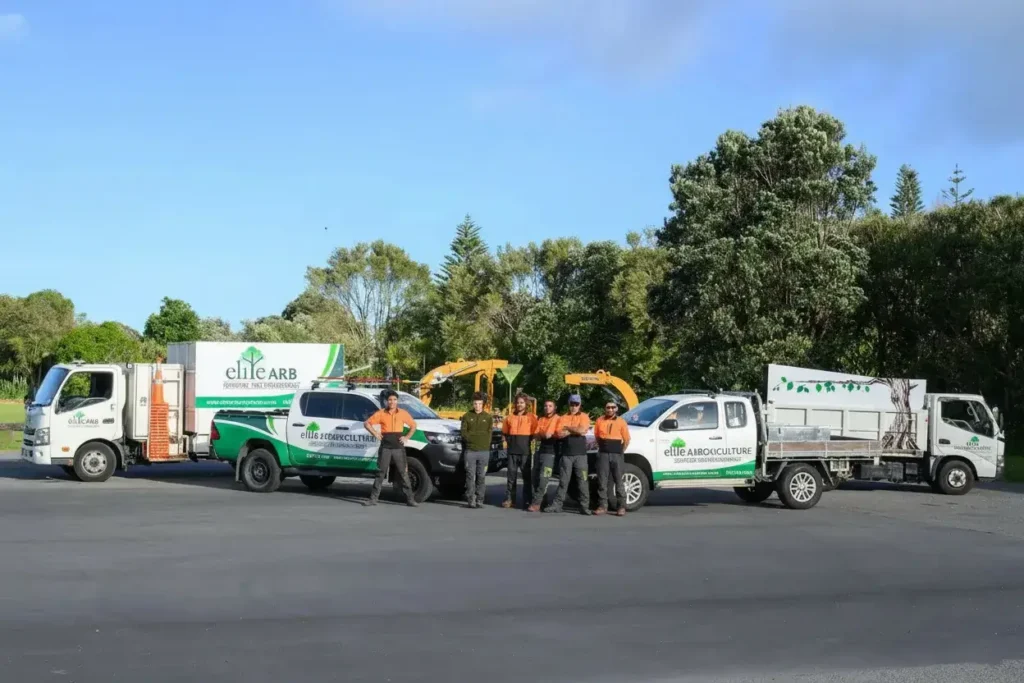
At Elite Arboriculture, we’ve brought the same certified, insured, safety-first approach that’s earned our reputation across the Kāpiti Coast north into Levin and the wider Horowhenua. From a single fruit tree on a town section to a full shelterbelt on a rural block, we’ll tell you what needs doing now, what can wait, and what shouldn’t be touched at all.
Book Your Spring Tree Check in Levin and Horowhenua
Ready to get your trees sorted for spring? Elite Arboriculture provides professional tree pruning and arborist services in Levin and right across the Horowhenua district, from Fairfield and Playford Park to Ohau, Manakau, Foxton and Shannon.
Contact Jade at Elite Arboriculture on 027 343 8846 or email [email protected] to arrange a free, no-obligation assessment.
Want to understand more about who you’re hiring? Read our guide to what a tree surgeon does in Levin, or see our summer pruning guide for what comes next in the year.
Frequently Asked Questions
When is the best time to prune trees in Levin?
It depends on the tree. For most deciduous trees, late winter to early spring, just before the new growth flush, is ideal for structural work, while deadwood can be removed at almost any time. Spring-flowering trees are best pruned after they flower. Stone fruit such as plums and cherries are best pruned in summer after harvest to reduce silver leaf risk, and citrus between April and August to avoid lemon tree borer.
Can I prune trees during bird nesting season in New Zealand?
Yes, but with care. There’s no blanket ban on spring pruning, but the Wildlife Act 1953 makes it an offence to disturb or destroy the nest of a protected bird, and all native birds are protected. Nesting season runs roughly from August to January. Check hedges, shelterbelts and canopies before cutting, and if you find an active nest, leave that section until the chicks have fledged.
Why shouldn’t I prune my plum or lemon tree in spring?
Plums and other stone fruit are vulnerable to silver leaf, a fungal disease that infects trees through fresh pruning cuts and is most active in cool, wet conditions through winter and early spring. Lemons and other citrus attract the lemon tree borer, a native beetle that flies from mid-spring to autumn and lays its eggs in fresh cuts. Pruning stone fruit after harvest and citrus between April and August avoids both problems.
Can I trim a tree that’s growing near a power line myself?
Not if any part of the work is within four metres of the line. Under the Electricity (Hazards from Trees) Regulations 2003, no one may work within that Controlled Access Zone without Electra’s approval, so the job must be done by Electra or an Electra-approved contractor. Tree owners are responsible for keeping trees clear of the lines, and the grace period for the updated 2024 regulations ends on 16 October 2026. Electra may cover the first cut if certain conditions are met.
How much does spring tree pruning cost in Levin and Horowhenua?
Smaller trees and straightforward pruning typically start from $150-500, medium trees generally run $500-1,200, and larger or more complex work, such as tall shelterbelt reductions, can run from $1,500-3,000 or more. Access, green waste removal and proximity to power lines all affect the price. A free on-site assessment is the only reliable way to get an accurate figure for your property.
Source Links
- NIWA – The Climate and Weather of Manawatu-Wanganui (2nd edition) – https://niwa.co.nz/sites/default/files/NIWA_ManawatuWanganui_Climate_WEB.PDF
- Department of Conservation – Wildlife Act 1953 – https://www.doc.govt.nz/about-us/our-role/legislation/wildlife-act/
- New Zealand Legislation – Wildlife Act 1953 – https://www.legislation.govt.nz/act/public/1953/31/en/latest/
- Electra – Tree Safety and Planting Around Power Lines – https://electra.co.nz/tree-safety/
- Electra – 2024 Tree Regulations Guide – https://electra.co.nz/wp-content/uploads/2024/11/2024-Tree-Regulations-1.pdf
- Community Law – Trees and Neighbours – https://communitylaw.org.nz/community-law-manual/chapter-26-neighbourhood-life/trees/
- Yates New Zealand – Silver Leaf – https://www.yates.co.nz/problem-solver/diseases/silver-leaf/
- Yates New Zealand – Lemon Tree Borer – https://www.yates.co.nz/problem-solver/pests/lemon-tree-borer
- Te Ara, the Encyclopedia of New Zealand – Shelter on Farms – https://teara.govt.nz/en/photograph/15594/trimmed-macrocarpa-hedge
- Horowhenua District Plan – Schedule 3: Notable Trees – https://www.horowhenua.govt.nz/files/assets/public/v/1/districtplan2015/horowhenua-district-plan-2015-schedule-3-notable-trees.pdf
- New Zealand Arboricultural Association – https://www.nzarb.org.nz
- Elite Arboriculture – Horowhenua Services – https://elitearboriculture.co.nz/services/arborist-horowhenua/