
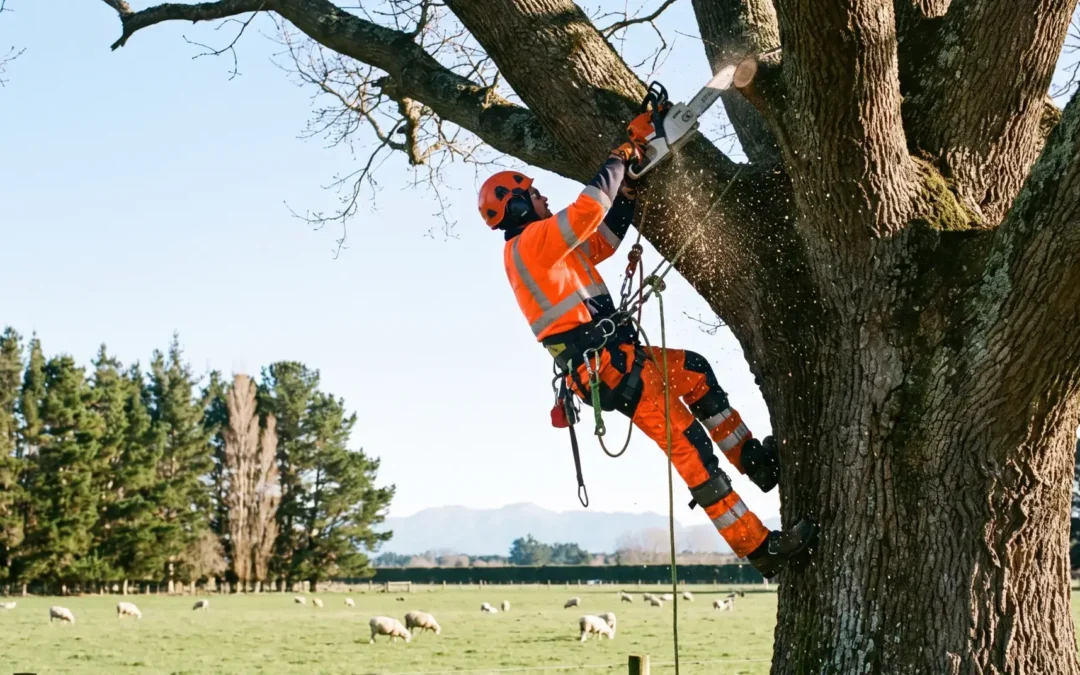
If your trees need professional care in Levin, it helps to actually understand what a tree surgeon does before you pick up the phone. Whether it’s a mature oak on a Fairfield section, a windbreak row on a lifestyle block out towards Ohau, or a shelterbelt that’s outgrown its job on a Manakau farm, the right call depends on knowing what you’re dealing with and who’s qualified to deal with it.
Tree surgeons, also known as arborists, bring formal training and hands-on experience to tree care that goes well beyond general gardening or a bloke with a chainsaw. Their work spans everything from precision pruning and disease diagnosis to complex removals and emergency storm response, all carried out to safety standards and within Horowhenua District Council’s rules. This guide explains what tree surgeons actually do, when you need one, and how professional tree surgery protects your property, your trees, and everyone around them.
Key Takeaways
- Tree surgeons are qualified professionals holding a New Zealand Certificate in Horticulture Services (Level 4) or higher in arboriculture
- Professional tree surgery covers diagnostic assessment, technical pruning, disease management, and complex removals requiring specialised equipment
- Horowhenua’s inland conditions, from Tararua Ranges wind exposure to widespread shelterbelts on rural and lifestyle-block properties, call for genuinely local expertise
- Situations that need a tree surgeon include large tree work, proximity to power lines, structural concerns, and Notable Tree management under the Horowhenua District Plan
- Qualified tree surgeons carry comprehensive insurance, safety certification, and ongoing professional development
- Council rules around Notable Trees and significant vegetation mean some jobs need professional assessment and documentation before any work begins
Understanding the Tree Surgeon Profession in New Zealand
Qualifications and Professional Standards
New Zealand’s tree surgeons work within a formal qualification structure designed to ensure genuine competency, not just willingness with a chainsaw.
The starting point for most professional tree surgeons is the New Zealand Certificate in Horticulture Services (Level 4), specialising in arboriculture. This covers tree biology, climbing technique, pruning method, pest and disease identification, and the safety protocols that underpin every job. It’s the baseline industry standard, and it’s worth asking about directly when you’re getting quotes.
From there, practitioners can progress to Level 5 qualifications and the New Zealand Diploma in Arboriculture (Level 6), which build toward tree risk assessment, advanced rigging, and consultancy-level knowledge — the sort of expertise needed for heritage tree management and detailed technical reports.
Many New Zealand arborists also hold International Society of Arboriculture (ISA) Certified Arborist credentials. It’s a voluntary, globally recognised certification that requires ongoing education to maintain, so it’s a reasonable proxy for someone actively keeping their knowledge current rather than resting on a qualification from a decade ago.
There’s also an apprenticeship route: roughly 28 months of supervised, on-the-job training combined with structured study through providers such as Primary ITO, allowing people to earn while they learn the trade properly.
None of this is a box-ticking exercise. Continuing professional development, through requalification, workshops, and industry seminars, keeps practitioners current as techniques, equipment, and regulations evolve. Elite Arboriculture’s team maintains current certification across the board, which matters just as much on a Levin lifestyle block as it does on a Paraparaumu section.
Essential Skills and Specialised Knowledge
Formal qualifications are the foundation, but the day-to-day work of a tree surgeon draws on a specific mix of physical skill and technical judgement that general tree services simply don’t have.
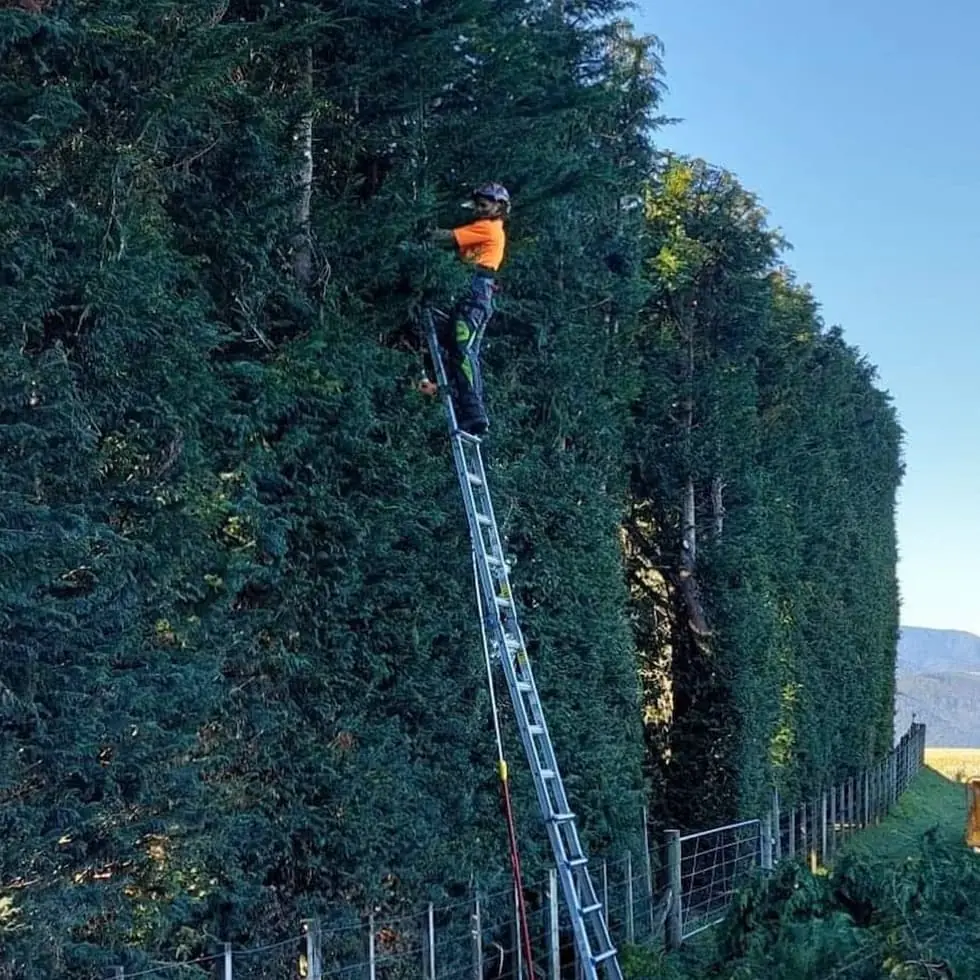
Climbing ability, using ropes, harnesses and rigging systems, allows safe access into the canopy for precise, selective cuts rather than blunt hacking from a ladder. On a tall macrocarpa in a shelterbelt row, that’s the difference between a clean job and a genuinely dangerous one.
Chainsaw skill goes further than cutting — it covers sectional dismantling, controlled felling, and reading how a particular piece of timber is going to behave under tension before the saw ever touches it. Understanding tree biology shapes every decision that follows: how a tree will respond to a cut, where the wound will callus over cleanly, and how much can safely be removed in one visit.
Disease and pest diagnosis matters just as much in a Levin backyard as it does on a commercial orchard block. Catching a problem early, while treatment is still viable, is far cheaper and far less risky than dealing with a compromised tree that’s been left to decline. Risk assessment ties it together: spotting the compromised branch, the weak attachment, or the decay pocket that an untrained eye would walk straight past.
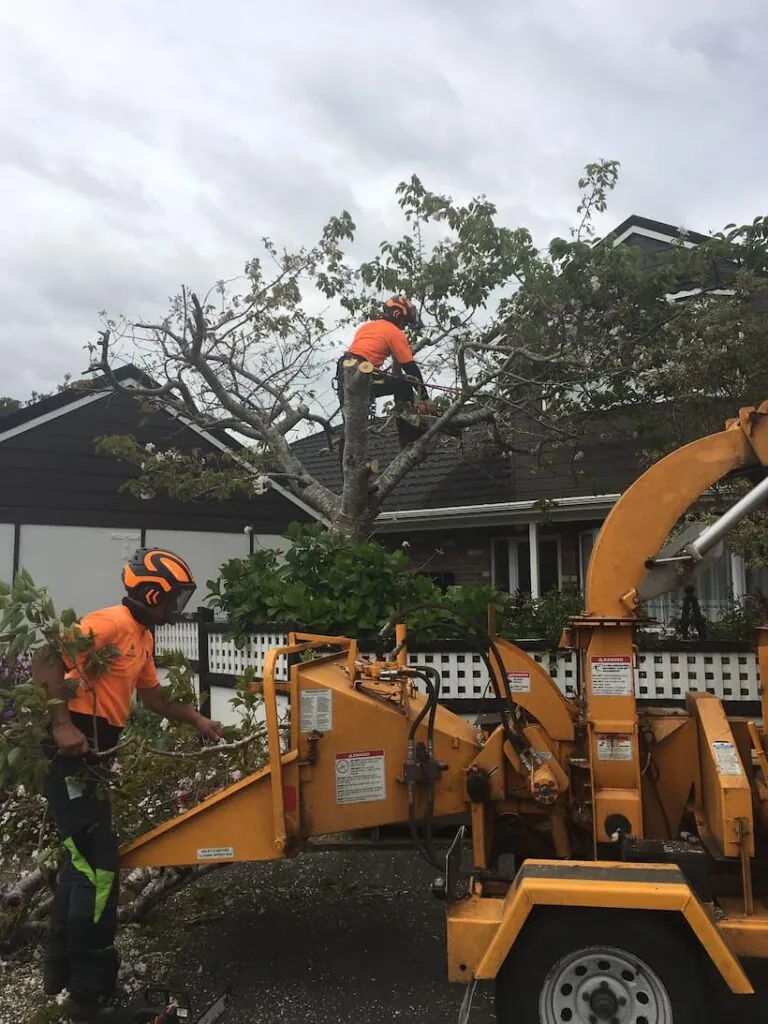
Add specialised equipment (elevated platforms, wood chippers, rigging gear) and you’ve got a skill set that a general gardening or lawn-mowing service, however capable, simply hasn’t trained for.
Comprehensive Tree Surgery Services in Levin
Diagnostic Assessment and Tree Health Evaluation
Every good piece of tree work starts with an honest assessment, not a quote scribbled on the back of an envelope.
A proper visual inspection picks up the obvious problems: dead branches, pest activity, structural defects. Experienced tree surgeons also catch the subtler signs — the ones that suggest a developing problem rather than an active emergency.
Structural assessment looks at branching pattern, attachment strength and load distribution, identifying issues like co-dominant stems or included bark before they become a failure. Species identification matters too: Horowhenua properties carry everything from native tōtara and kahikatea to long-established exotic shelterbelt species, and each responds differently to pruning and stress.
Soil and site conditions get factored in as well. Levin’s soils, and the wider district’s mix of free-draining river terraces and heavier lowland ground, affect root development and drainage in ways that genuinely change the right course of action. A tree struggling because of waterlogged roots needs a very different response to one suffering storm damage. Proper documentation and reporting give you a clear record of condition, recommended action and priority — useful for your own decision-making, and for insurance or council purposes if it comes to that.
Technical Pruning and Canopy Management
Precision pruning is core tree surgeon work, and it looks quite different depending on what’s actually growing on your property.
Structural pruning on young trees builds a strong framework early, which matters more in Horowhenua than it might elsewhere — trees here need to cope with stronger easterly winds funnelling off the Tararua Ranges rather than the salt-laden coastal gusts further south. Getting the structure right while the tree is young reduces storm-damage risk for decades afterwards.
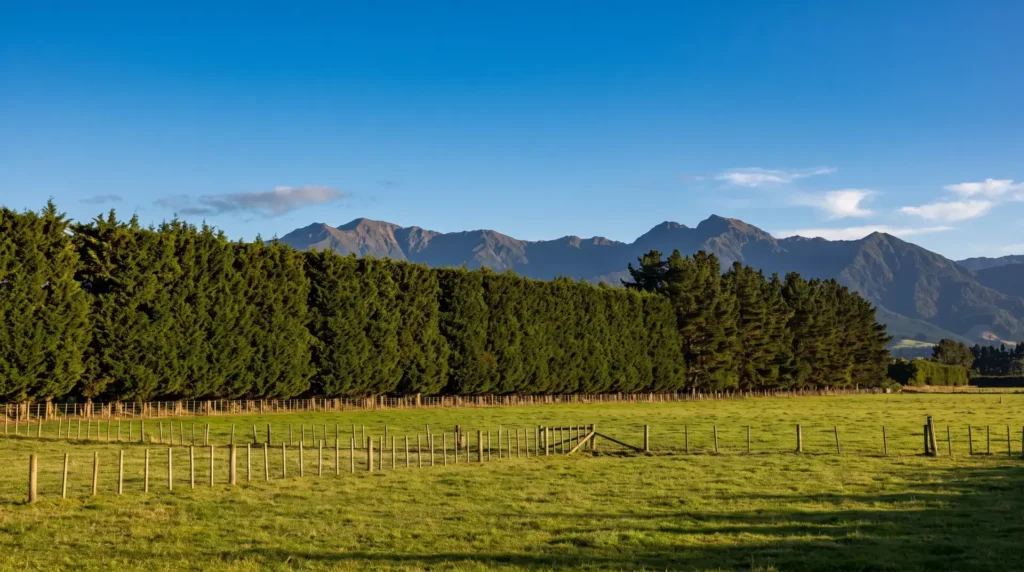
Shelterbelt maintenance deserves its own mention, since it’s such a fixture of the district. Macrocarpa and pine rows planted generations ago still do genuine work protecting stock, crops and homes from wind, but they need regular side-face trimming to stay within their footprint and keep doing that job safely. Left unmanaged, a shelterbelt becomes top-heavy, shades out neighbouring paddocks, and turns into exactly the kind of storm-damage risk it was planted to prevent.
Crown reduction manages size without leaving a tree looking hacked about, while deadwood removal clears genuinely hazardous material without touching branches that only look compromised to an untrained eye. Thinning improves light and airflow through a dense canopy and reduces wind resistance, which counts for a lot on an exposed rural section. All of it should stay conservative: removing more than 15-20% of live canopy in a season stresses a tree more than it helps it.
Complex Tree Removal and Emergency Services
Sometimes a tree genuinely has to come down, and the more difficult the site, the more the job depends on real expertise rather than raw effort.
Sectional dismantling handles trees in tight spots, close to sheds, fence lines or houses, where a straightforward fell isn’t an option. Rigging controls each section as it comes down, protecting whatever’s underneath. Precision felling, by contrast, suits open paddock or section space, where directional cutting can drop a tree cleanly in open ground — useful across Horowhenua’s larger rural properties in a way it rarely is on a tight coastal section.
For the genuinely oversized jobs, crane-assisted removal brings in extra capability when conventional rigging carries too much risk. Stump grinding finishes the job cleanly, leaving a surface ready for replanting or whatever comes next. And when a storm brings a branch down across a driveway or a tree partially fails overnight, emergency response prioritises the immediate hazard first and works out the rest from there.
When Levin Properties Need Professional Tree Surgeons
Height and Access Challenges
Working above ground level changes the risk profile of a job entirely, and that’s where professional training earns its keep.
As a rough guide, anything beyond minor outer-canopy work on a tree over three metres warrants a professional. Power line proximity is non-negotiable — even work that doesn’t make contact still carries real electrical risk, and there are mandated clearance zones that only qualified people are permitted to work within.
Confined spaces (trees hard up against a house, packed in close to a boundary fence, or wedged between outbuildings) complicate access and raise the technical bar. So does difficult terrain: a number of Horowhenua properties sit on sloping or uneven rural ground where footing alone becomes a genuine safety consideration. And where a tree overhangs a neighbouring property, a shared driveway or stock yards, liability becomes part of the equation too — which is exactly what a tree surgeon’s insurance is there for.
Tree Health Problems and Disease Management
Some tree health issues are well beyond a DIY assessment, and waiting too long to call someone rarely ends well.
Unexplained decline, without an obvious cause, is worth a professional look before it goes further. Fungal issues, including bracket fungi and root rot, can compromise a tree’s structural integrity long before it’s visually obvious, and identifying them early keeps your options open. Pest pressure from scale insects, borers or other damaging species is far easier and cheaper to manage when it’s caught early rather than after it’s taken hold.
Root damage from nearby earthworks, compaction, or underground services doesn’t always show above ground straight away, but it can undermine a tree’s stability over time. And sudden, unexplained branch failure is often a sign of a hidden structural problem rather than bad luck — worth a proper assessment rather than a guess.
Compliance and Regulatory Requirements
Horowhenua’s tree rules sit in the Horowhenua District Plan, and the category that matters most is Notable Trees.
Trees listed in Schedule 3 of the District Plan are protected: no one may remove, damage or destroy a Scheduled Notable Tree without going through the council’s process first. Trees earn that listing based on condition, age, stature, visibility, and historical or ecological significance — Horowhenua has everything from ancient native specimens to well-known exotic plantings on the register, including a notable rimu recorded in Shannon. It’s genuinely worth checking the schedule before any significant work, since removing or damaging a listed tree without consent carries real consequences.
Beyond the Notable Trees list, the District Plan also has rules around vegetation clearance more broadly, and activities near waterways (relevant given Lake Horowhenua’s status as an Outstanding Natural Feature) fall under a shared responsibility between Horowhenua District Council and Horizons Regional Council. If your property borders the lake, a waterway, or a wetland margin, it’s worth checking which authority’s rules actually apply before assuming it’s straightforward.
None of this needs to be daunting. A tree surgeon who already knows the District Plan can tell you in a phone call whether your situation needs a resource consent application, and can prepare the technical documentation to support one if it does.
Tree Surgery vs General Tree Services: Understanding the Difference
Qualification and Training Requirements
It’s worth being clear-eyed about the difference between a qualified tree surgeon and a general tree service, because the gap is bigger than the price difference sometimes suggests.
Qualified tree surgeons complete nationally recognised training that combines practical skill with real theoretical grounding. General tree service operators may have picked up genuine experience over the years, but without formal qualification there’s no external verification of what they actually know. Apprenticeship completion and ongoing professional development show a level of structured skill-building that experience alone doesn’t guarantee, and membership of the New Zealand Arboricultural Association signals a commitment to industry standards and an actual code of practice, not just a willingness to turn up with a chainsaw.
Insurance and Liability Protection
This is where the difference becomes financially real, not just theoretical.
Proper public liability cover, typically well over a million dollars, protects you if something goes wrong: a branch through a shed roof, damage to a neighbour’s fence, an accident involving anyone on site. Professional indemnity cover backs up the advice a tree surgeon gives you, and workers’ compensation protects anyone working on your property if they’re injured doing it.
An uninsured operator might quote cheaper, but if something goes wrong on a rural Horowhenua property, with stock, sheds, fences and neighbouring farms all in the mix, the cost of that gap can dwarf whatever you saved on the quote. Always ask to see current insurance documentation before work starts — a properly insured tree surgeon will hand it over without hesitation.
Benefits of Hiring Elite Arboriculture’s Tree Surgeons in Levin
Local Knowledge and Horowhenua Expertise
Horowhenua isn’t simply “a bit further up the coast” from Kāpiti, and treating it that way shows.
Sitting inland, east of Lake Horowhenua and in the lee of the Tararua Ranges, the district trades salt-laden coastal wind for something different: stronger, drier easterlies funnelling off the hills, hotter and drier summers, and colder frosts overnight through winter since there’s no sea nearby to moderate the temperature swing. That combination shapes everything from which species genuinely thrive here to how often a shelterbelt needs trimming to keep doing its job.
The property mix is different too. Alongside in-town sections in Levin, Fairfield and Playford Park, a large share of Horowhenua’s tree work happens on lifestyle blocks and working farms stretching out towards Ohau, Manakau, Foxton and Shannon, where a single tree is often doing a job (shelter, shade for stock, a boundary marker) rather than standing alone in a garden. Understanding that context changes the advice a tree surgeon gives you, not just the price.
Elite Arboriculture built its reputation on the Kāpiti Coast with exactly this kind of property-specific thinking, and we’ve brought the same approach north into Horowhenua rather than a one-size-fits-all coastal playbook.
Safety Standards and Professional Equipment
None of the above counts for much without properly maintained equipment and genuinely current safety systems behind it.
That means height-safety gear (harnesses, ropes, rigging) inspected and replaced on a proper schedule, chainsaws and cutting tools maintained to spec, and full PPE worn as standard rather than as an afterthought. On rural properties it also means traffic and access management where a job sits near a road, and site protection that leaves gardens, driveways and stock areas undamaged once the work’s done. Emergency response planning, including first aid training and clear communication systems, rounds out a genuinely professional operation.
Cost Considerations and Value of Professional Tree Surgery
Understanding Tree Surgery Pricing
Tree surgery pricing reflects complexity and risk, not a flat hourly rate, and it’s worth understanding what actually drives the number on your quote.
As a general guide, smaller, straightforward trees typically start from $150-500. Medium trees, or jobs with moderate access difficulty, usually land in the $500-1,200 range. Larger or more complex removals, particularly where crane assistance, extensive rigging, or difficult rural access is involved, can run from $1,500-3,000 or more. Disposal costs (chipping, loading, transport) factor into the total, and anything urgent, like storm damage requiring an after-hours callout, typically carries a premium reflecting the disruption and urgency involved.
If your situation needs a resource consent under the Horowhenua District Plan, factor in the time and documentation that adds too — though a tree surgeon who already knows the process can usually keep that straightforward rather than turning it into its own project.
The most useful comparison isn’t against doing nothing, though. It’s against what a delayed or DIY-gone-wrong situation actually costs: property damage from a failure that could have been caught early, an emergency callout at a premium rate, or the loss of a mature tree that proper maintenance could have saved.
Long-Term Cost Benefits
Viewed over years rather than a single job, professional tree care is closer to an investment than an expense.
Regular, preventive attention catches developing problems while they’re still cheap and straightforward to fix, rather than after they’ve become an emergency. It also extends the working life of mature trees and shelterbelts that would otherwise cost a great deal to establish again from scratch — a mature shelterbelt in particular represents decades of growth that’s genuinely expensive to replace. Reducing the risk of storm-related property damage, keeping documentation that can support an insurance claim if needed, and simply maintaining a well-cared-for property all add up over time in ways a single invoice doesn’t capture.
Conclusion
Professional tree surgery combines real qualifications, the right equipment, and genuine local knowledge to handle tree care that’s beyond general gardening capability, and increasingly, that’s exactly what Horowhenua properties need as the district’s tree cover matures. Understanding when your Levin trees need a qualified tree surgeon protects the trees themselves, your property, and everyone around them.
Elite Arboriculture brings the same certified, insured, safety-first standard we’ve built our reputation on across the Kāpiti Coast north into Levin and the wider Horowhenua district. Whether it’s a single tree in town or a shelterbelt on a rural block, the work deserves someone who actually knows the difference.
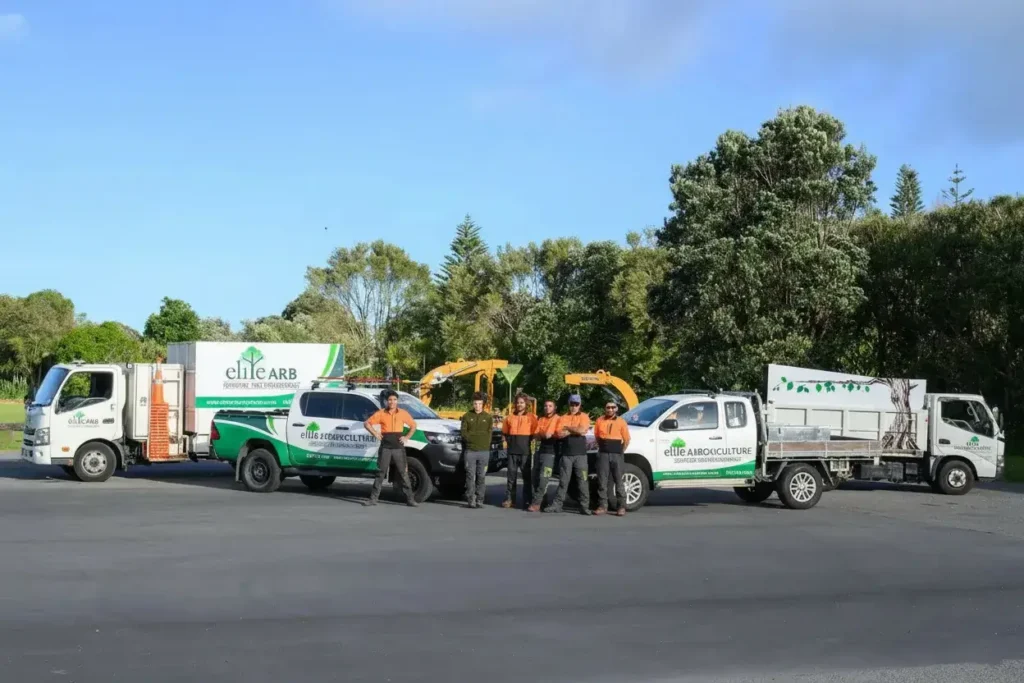
Expert Tree Surgery Services Throughout Levin and Horowhenua
Ready to talk to someone qualified about your trees? Elite Arboriculture provides professional tree surgery throughout Levin and the wider Horowhenua district, bringing certified expertise and genuine local knowledge to every job, whether it’s in town or out on a rural block.
Contact Jade at Elite Arboriculture on 027 343 8846 or email [email protected] to arrange a free, no-obligation assessment.
Frequently Asked Questions
What qualifications should I look for when hiring a tree surgeon in Levin?
Look for at least a New Zealand Certificate in Horticulture Services (Level 4) specialising in arboriculture — the industry-standard qualification for professional tree surgery. Level 5 certificates or the Level 6 Diploma in Arboriculture indicate more advanced expertise, and ISA Certified Arborist credentials show international recognition and a commitment to ongoing development. Always confirm current certification, comprehensive insurance, and safety training before booking any work.
How do I know if my tree needs a professional tree surgeon or if I can handle it myself?
Professional help becomes essential once you’re dealing with height above three metres, proximity to power lines, large branch removal, or any situation where falling material could damage property, stock, or fencing. Unexplained decline, structural concerns like dead branches or weak attachments, and anything involving a tree listed in the Horowhenua District Plan’s Notable Trees schedule all warrant a professional assessment rather than a DIY attempt.
Are tree surgeons and arborists the same thing in New Zealand?
Yes — the two terms are used interchangeably here to describe qualified tree care professionals holding formal arboriculture training. Some practitioners favour one term over the other, but what actually matters when you’re choosing who to hire is verified qualifications, insurance, and experience, not which word they use to describe themselves.
Do I need council consent for tree work in Levin, and can a tree surgeon help with that?
It depends on whether the tree is listed as a Notable Tree under Schedule 3 of the Horowhenua District Plan, or falls under the district’s broader vegetation clearance rules. A tree surgeon who already knows the District Plan can tell you quickly whether your situation needs a resource consent, and can prepare the technical assessment and documentation to support an application if one’s required.
How much does professional tree surgery cost in Levin?
Costs depend on the tree’s size, condition and how accessible it is. Smaller, straightforward jobs typically start from $150-500, medium trees generally run $500-1,200, and larger or more complex removals — including rural jobs needing extra access or rigging — can run from $1,500-3,000 or more. A free, on-site quote is the only reliable way to get an accurate figure for your specific property.
Source Links
- New Zealand Arboricultural Association – https://www.nzarb.org.nz
- Careers New Zealand – Arborist – https://www.careers.govt.nz/jobs-database/farming-fishing-forestry-and-mining/agriculture-horticulture/arborist/
- Otago Polytechnic – Arboriculture Qualifications – https://www.op.ac.nz/study/horticulture/arboriculture
- Primary ITO – New Zealand Apprenticeship in Arboriculture – https://www.primaryito.ac.nz/programme-listing-page/new-zealand-apprenticeship-in-arboriculture
- Horowhenua District Council – Trees & Vegetation – https://www.horowhenua.govt.nz/Services/Building-Planning-Services/Trees-Vegetation
- Horowhenua District Plan – Schedule 3: Notable Trees – https://www.horowhenua.govt.nz/files/assets/public/v/1/districtplan2015/horowhenua-district-plan-2015-schedule-3-notable-trees.pdf
- Horizons Regional Council – https://www.horizons.govt.nz
- ISA Certified Arborist Programme – https://www.nzarb.org.nz/certified-arborist-exam
- Wintec – Arboriculture Programmes – https://www.wintec.ac.nz/study-at-wintec/courses/arboriculture
- Elite Arboriculture – Levin Services – https://elitearboriculture.co.nz/services/arborist-levin/