
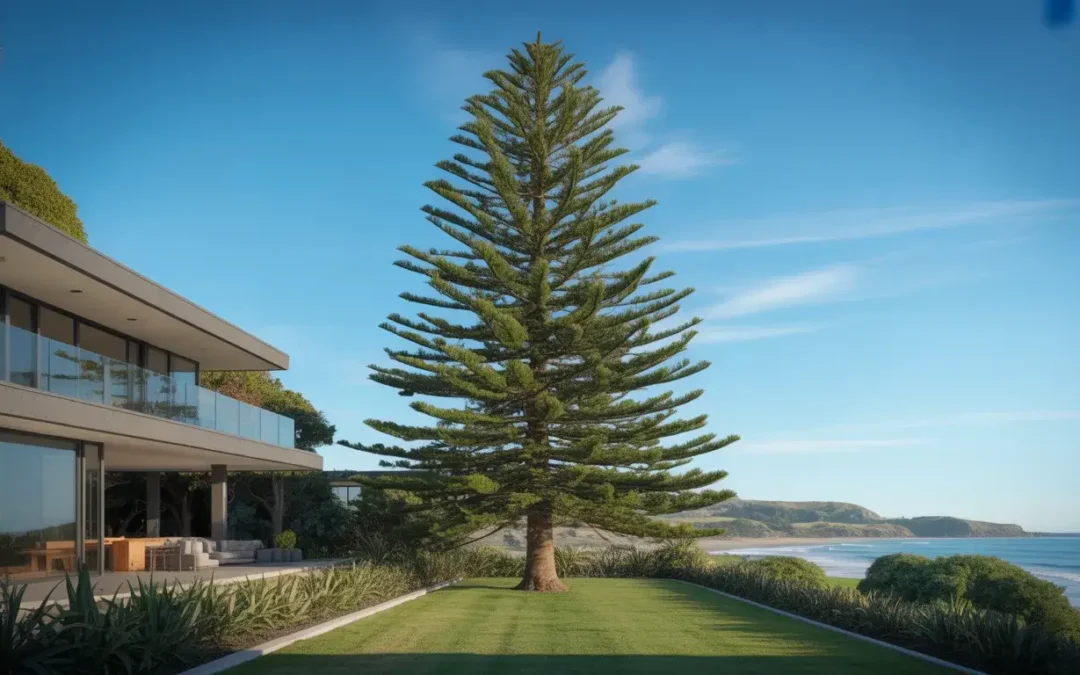
Norfolk Pines stand as majestic sentinels throughout the Kapiti Coast, their distinctive symmetrical branches creating iconic silhouettes against our coastal skyline. However, when these impressive trees begin to decline or pose safety risks, their removal becomes a complex undertaking requiring specialist knowledge and careful consideration of legal requirements.
These evergreen conifers, despite their misleading name, are not true pines but members of the ancient Araucaria family, and can reach heights of 30 metres with spreads of 18 metres in New Zealand’s climate. More concerning is their potential to create 6kg cones that can cause serious damage, especially when falling from significant heights.
This comprehensive guide examines the complexities of Norfolk Pine removal, from initial assessment through legal compliance and safe removal methodologies. For Kapiti Coast property owners facing Norfolk Pine concerns, Elite Arboriculture provides expert evaluation and professional removal services tailored to your specific circumstances.
Key Takeaways
- Norfolk Pines are frequently protected under district plans, requiring resource consent before removal
- These trees present unique safety challenges due to their size, structure, and potential for sudden branch failure
- Professional assessment is essential to identify declining trees before they become emergency situations
- Removal costs can range significantly based on tree size, location, and complexity of access
- Early intervention is more cost-effective than emergency response after tree failure
Understanding Norfolk Pine Risks in the Kapiti Region
The Hidden Dangers of Declining Norfolk Pines
Norfolk Pines present deceptive risks that often remain invisible until catastrophic failure occurs. Real-world examples from Auckland demonstrate the serious dangers – branches falling through roofs, narrowly missing occupants, and causing extensive property damage over multiple years. One Wellington property owner described their experience: “The tree has been trying to kill us for the last few years – that’s the bottom line” after years of declining health and dangerous branch drops.
The Kapiti Coast’s exposed coastal environment places additional stresses on these trees. Salt-laden winds, storm exposure, and our region’s clay soils create conditions that can accelerate decline in already compromised specimens. Unlike smaller trees that fail gradually, Norfolk Pines often retain their overall appearance while internal structural integrity deteriorates significantly.
Elite Arboriculture’s experience with Kapiti’s Norfolk Pines reveals several common risk factors. Trees struck by lightning often develop internal decay that remains invisible for years. Soil compaction from development or changes in drainage patterns can stress root systems, leading to gradual destabilisation.
Recognising the Warning Signs
Early identification of Norfolk Pine problems can prevent emergency situations and reduce removal complexity. Property owners should monitor for several key indicators that suggest professional assessment is needed.
Visible crown dieback represents one of the most serious warning signs. Unlike deciduous trees that naturally shed leaves, Norfolk Pines showing brown or dying sections in their crown often indicate systemic health problems. Lightning strikes to the crown, even years previous, can create ongoing decline patterns that progressively worsen over time.
Changes in branch drop patterns warrant immediate attention. While Norfolk Pines naturally shed some lower branches, an increase in frequency or size of falling branches suggests structural deterioration. Branches weighing 80 kilograms or more can fall unexpectedly, creating life-threatening situations for anyone below.
Legal Requirements and Council Compliance
Protected Tree Status in New Zealand
Norfolk Pines are commonly protected trees throughout New Zealand, including Auckland and many other councils, requiring resource consent before removal. This protection status stems from their unique characteristics – being found only in a unique location between New Zealand and New Caledonia – and their significant contribution to New Zealand’s urban forest canopy.
The protection framework operates under the Resource Management Act, with each council maintaining schedules of notable trees that receive special protection. Trees may be protected because they’re scheduled as notable, listed, or protected by resource consent conditions or property title covenants. Property owners must understand their tree’s status before undertaking any work.
Even when trees present serious safety risks, the Environment Court has emphasised that removal would be reasonable only in cases of serious risk to human life and property. However, the legal framework recognises legitimate safety concerns, with provisions for emergency removal when immediate dangers exist.
Kapiti Coast District Council Requirements
Kapiti Coast District Council has simplified tree protection rules, with only about 1,300 trees now protected on approximately 400 properties, compared to over 10,600 previously protected. This represents a fundamental shift toward protecting only the most significant indigenous trees while providing greater freedom for property owners.
The council has confirmed that when resource consents are required, the cost is zero, recognising the public good of retaining significant established trees. Property owners also have much more freedom to trim protected trees without resource consent, provided the work follows arboricultural best practices.
For trees not classified as protected, removal may be permitted if the area requires stabilisation against erosion or if removal prevents loss of life or damage to property. However, determining protection status requires careful investigation, as significant indigenous vegetation classifications can vary between species and involve specific size criteria.
Professional Removal Process and Methodology
Comprehensive Pre-Removal Assessment
Elite Arboriculture’s Norfolk Pine assessment begins with systematic evaluation using internationally recognised arboricultural standards adapted for New Zealand conditions. Our certified arborists examine crown structure, trunk integrity, root indicators, and site-specific factors that influence removal complexity and safety requirements.
Advanced assessment techniques may include resistance drilling to identify internal decay patterns invisible from external examination. Norfolk Pines can suffer significant internal damage from events like lightning strikes years before external symptoms become apparent. Sonic tomography provides detailed imaging of internal structure, particularly valuable for large specimens where internal condition directly impacts removal safety.
The assessment process considers access limitations, proximity to structures, utility lines, and valuable landscape features requiring protection during removal. For Norfolk Pines near heritage buildings or in confined urban settings, detailed planning becomes critical for preventing collateral damage during dismantling operations.
Specialised Equipment and Safety Protocols
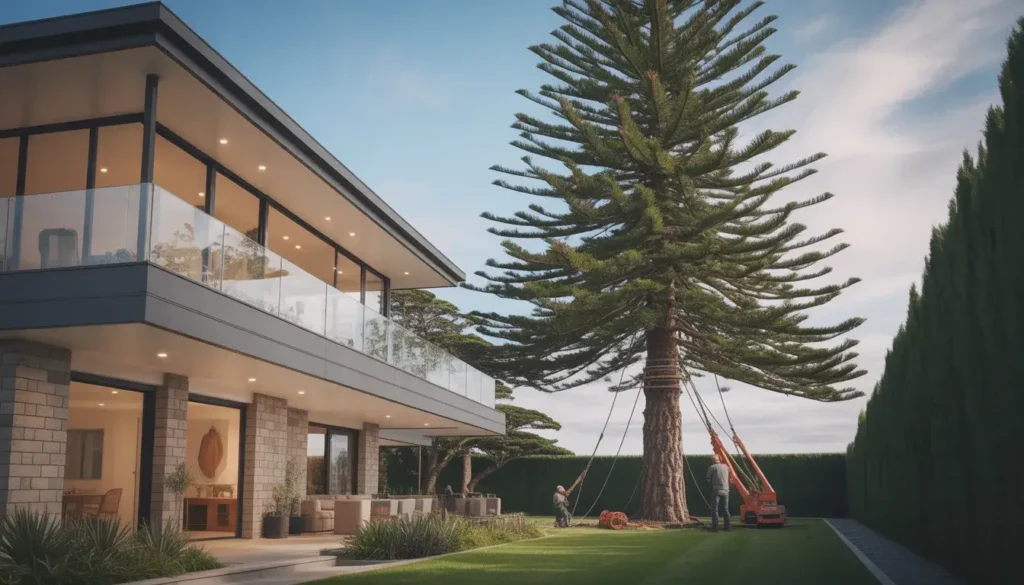
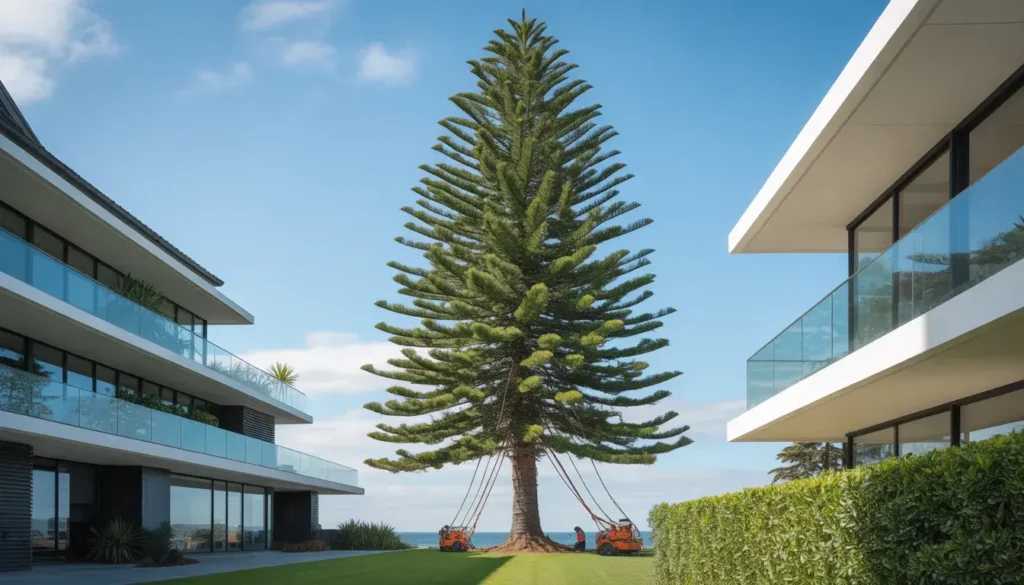
Norfolk Pine removal demands equipment specifically suited to their unique characteristics and substantial size. Professional removal operations typically involve advanced rigging systems with ropes running from tree tops to ground level, aerial work platforms, and specialised cutting equipment designed for large-scale tree dismantling.
Our team utilises crane-assisted removal when appropriate, allowing precise control of large sections while minimising ground impact. For trees in confined locations, advanced rigging techniques enable controlled lowering of substantial trunk sections without property damage.
Professional operations require comprehensive safety protocols, including specialised cutting equipment, aerial work platforms for safe access to heights, and protective barriers for public safety. Elite Arboriculture maintains comprehensive insurance coverage and adheres to WorkSafe New Zealand standards throughout all operations.
Systematic Dismantling Approach
Professional Norfolk Pine removal follows a systematic top-to-bottom approach, beginning with crown reduction and progressing through careful trunk sectioning. This methodical process ensures controlled removal while protecting surrounding property and landscape features.
The operation typically begins with removal of upper crown sections using climbing techniques or aerial platforms. Lower branches are removed systematically before trunk sectioning begins, with each section carefully controlled to prevent unexpected movement. Advanced rigging systems distribute loads safely while enabling precise placement of removed sections.
Complete removal includes professional stump grinding or extraction depending on site requirements and future landscape plans. Norfolk Pine stumps can be processed for various uses, from mulch production to lumber processing for suitable applications.
Cost Considerations and Value Benefits
Understanding Removal Investment
Norfolk Pine removal represents a significant investment that varies substantially based on tree characteristics and site complexity. Professional removal costs typically range from $1,500-$4,500 for large Norfolk Pines, with complex removals in challenging locations potentially reaching $8,000-$15,000 for particulartly large specimens, reflecting the specialised equipment, expertise, and time required for safe operations.
Several factors influence removal costs including tree height and diameter, with taller specimens requiring more complex equipment and safety measures. Access limitations significantly impact pricing, as trees near structures or with restricted access routes require more sophisticated removal techniques and extended operation timeframes.
The tree’s condition affects costs considerably. Declining or structurally compromised trees require additional safety precautions and may necessitate more complex removal sequences. Emergency removal situations typically involve premium pricing due to urgency and increased risk factors.
Wood Recovery and Resource Utilisation
Norfolk Pine timber offers excellent characteristics with even texture, appearance similar to kauri, and suitability for various applications including construction, furniture, and specialty products. Professional removal can recover significant value from quality timber sections.
The wood holds screws and nails well, takes paint and stain easily, and machines cleanly with smooth surface finishes suitable for mouldings and timber profiles. For property owners interested in resource recovery, Elite Arboriculture can coordinate with local mills for timber processing or arrange custom cutting for specific applications.
Alternative utilisation options include firewood processing for heating applications, mulch production for landscape use, or complete material removal based on client preferences. These value recovery opportunities can offset removal costs while supporting sustainable resource management principles important to environmentally conscious property owners.
Elite Arboriculture’s Norfolk Pine Expertise
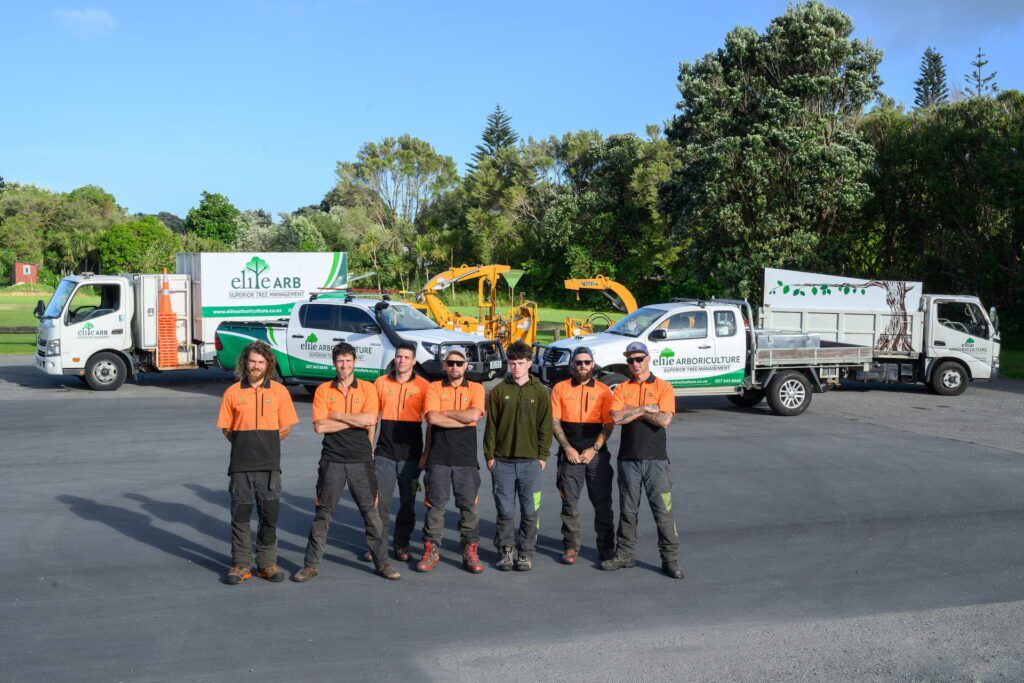
Elite Arboriculture brings specialised expertise in Norfolk Pine management to properties throughout the Kapiti Coast region. Our team’s extensive experience with these unique trees includes understanding their behaviour in coastal environments, typical decline patterns, and effective removal strategies for various site conditions.
Jade Darbyshire’s leadership ensures every Norfolk Pine project receives expert attention from initial assessment through final site restoration. Our team’s deep understanding of local council requirements, environmental factors, and community standards delivers superior outcomes for property owners facing complex tree management decisions.
The Kapiti Coast’s exposure to coastal winds, salt air, and diverse soil conditions creates unique challenges for Norfolk Pine health and removal. Elite Arboriculture’s local experience provides valuable insights into these regional factors, enabling more accurate assessments and effective removal planning.
Alternative Management Strategies
When Removal Isn’t Immediately Possible
Property owners facing protected Norfolk Pines may need interim management strategies while pursuing removal consent or when immediate removal isn’t feasible. Elite Arboriculture provides comprehensive maintenance services designed to reduce risks while preserving trees until removal becomes possible.
Professional pruning can remove dead, damaged, or high-risk branches while maintaining the tree’s natural form. However, Norfolk Pines require careful pruning approaches as cutting the main leader can result in misshapen growth patterns. Our arborists specialise in species-appropriate pruning that reduces immediate hazards without compromising tree structure.
Regular professional inspections help monitor declining trees and document changing conditions that may support future removal applications. Elite Arboriculture’s assessment services provide detailed documentation of tree condition changes over time, creating evidence that supports consent applications when safety concerns develop.
Conclusion
Norfolk Pine removal represents one of the most complex tree management challenges facing Kapiti Coast property owners. These magnificent trees, while contributing significantly to our coastal landscape character, can present substantial risks when declining or inappropriately located near structures.
The combination of potential protected status, significant safety considerations, and technical removal complexity demands professional expertise throughout the entire process. Elite Arboriculture’s comprehensive approach ensures property owners receive expert guidance from initial assessment through successful removal completion while maintaining full regulatory compliance.
Proactive management of Norfolk Pine concerns delivers superior outcomes compared to reactive emergency responses. Early professional assessment identifies developing problems while removal options remain most flexible and cost-effective.
Contact Elite Arboriculture for Expert Norfolk Pine Assessment
Don’t wait for your Norfolk Pine to become an emergency situation. Contact Elite Arboriculture today for professional assessment and expert removal services tailored to Kapiti Coast conditions.
Contact Jade at Elite Arboriculture on 027 343 8846 or email [email protected] to schedule your Norfolk Pine assessment with the Kapiti Coast’s trusted arborists.
Frequently Asked Questions
How can I determine if my Norfolk Pine is protected before planning removal?
Norfolk Pine protection status varies by council and specific tree characteristics. Trees may be protected as notable or scheduled trees, through resource consent conditions, or by property title covenants. Elite Arboriculture provides comprehensive protection status investigation as part of our assessment service, including council database searches and property title examination. We recommend professional status determination before undertaking any work, as penalties for unauthorised removal of protected trees can be substantial.
What timeline should I expect for the complete Norfolk Pine removal process?
Norfolk Pine removal timelines depend on protection status, council requirements, and operational complexity. Protected trees requiring resource consent may need 4-8 weeks for application processing, though Kapiti Coast District Council provides zero-cost consents recognising the public good of tree management. Non-protected trees can often be removed within 1-2 weeks of assessment completion. Large Norfolk Pine removal operations typically require 1-3 days depending on size and access conditions.
How does Norfolk Pine removal cost compare to potential property damage from tree failure?
Professional removal costs typically range from $1,500-$4,500 for large Norfolk Pines, with complex removals in challenging locations potentially reaching $8,000-$15,000 on average for large specimens in complex locations, this investment often proves economical compared to property damage costs. Documented cases show years of repeated damage including branches falling through roofs, damaging vehicles, and creating ongoing safety hazards. Emergency removal typically costs significantly more than planned operations, while property damage can involve substantial repair costs and insurance complications.
Source Links
- New Zealand Arboricultural Association – https://www.nzarb.org.nz
- WorkSafe New Zealand Arboriculture Safety – https://www.worksafe.govt.nz/topic-and-industry/forestry/health-and-safety-in-the-arboriculture-industry/
- Auckland Council Tree Protection – https://www.aucklandcouncil.govt.nz/building-and-consents/working-on-around-trees/
- Kapiti Coast District Council – https://www.kapiticoast.govt.nz
- Community Law Tree Information – https://communitylaw.org.nz/community-law-manual/chapter-27-neighbourhood-life/trees/
- International Society of Arboriculture – https://www.isa-arbor.com
- NZ Farm Forestry Association – https://www.nzffa.org.nz
- Treescape New Zealand – https://www.treescape.co.nz
- WorkSafe Tree Work Guidelines – https://www.worksafe.govt.nz/topic-and-industry/tree-work/
- New Zealand Forest Owners Association – https://www.nzfoa.org.nz